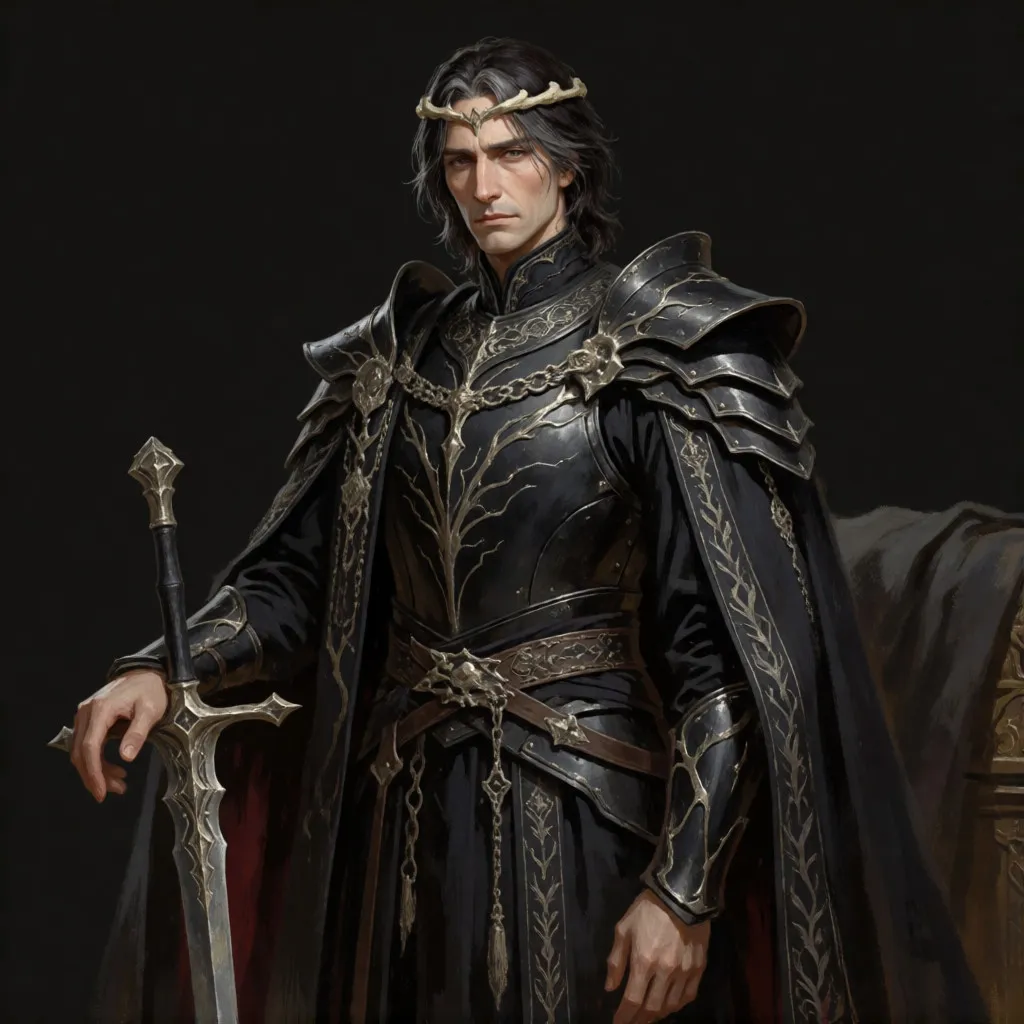
Varyon Veinwright was king of Iskandar, and the last of his line to sit its throne. The Veinwrights had ruled there for generations on rites the rest of the realm called forbidden — they kept their dead close, consulted them, and were feared for it.
He came to the crown in the ordinary way, and for a long while the record has little to say of him: grain prices, road tolls, the seasonal business of a kingdom that had not been threatened in three hundred years. Then the western provinces refused the winter levy, raised a broken red crown over the tax road, and declared themselves free of him.
In the civil war that followed, Varyon did the one thing his dynasty was least expected to do. He forbade the raising of the dead, and he is the only king of that line known to have forbidden it.
He was not obeyed. His commanders raised their fallen regardless, his priests went further, and the realm beyond Iskandar came to believe the king had ordered what he had outlawed. He had his own priesthood arrested. It changed nothing.
He rode with his army rather than sending it, and forbade his commanders the burning of villages and the seizure of grain. Twice he was offered terms, and twice refused. The second refusal brought the Justicar’s Legion through the eastern passes — an army that broke the separatists in a single day, then turned on the loyalists, the crypts, and the Veinwright families.
At his side hung the sword of the first Veinwright king, which had never been drawn in battle. He drew it once, on the steps of the Tomb of First Kings, against soldiers who had come to save Iskandar. It broke.
He was never deposed. He was still seated when the throne was dissolved by decree, and by then it governed little beyond the hall it stood in. His people left Iskandar by two roads, north into the ice and south into the waste; he did not go with them.
Whether the kingdom could have been saved by the surrender he refused, the Archive cannot say. It has been argued in every generation since.
Appears in
- The Civil War in Iskandar Three centuries of silence end on the morning the western tax road falls, and a court built to intimidate discovers it is surrounded.
- The Shadow Conspiracy A contract is refused in a gilded room and a second one is agreed, and a kingdom that has not yet heard of either is already being sold.