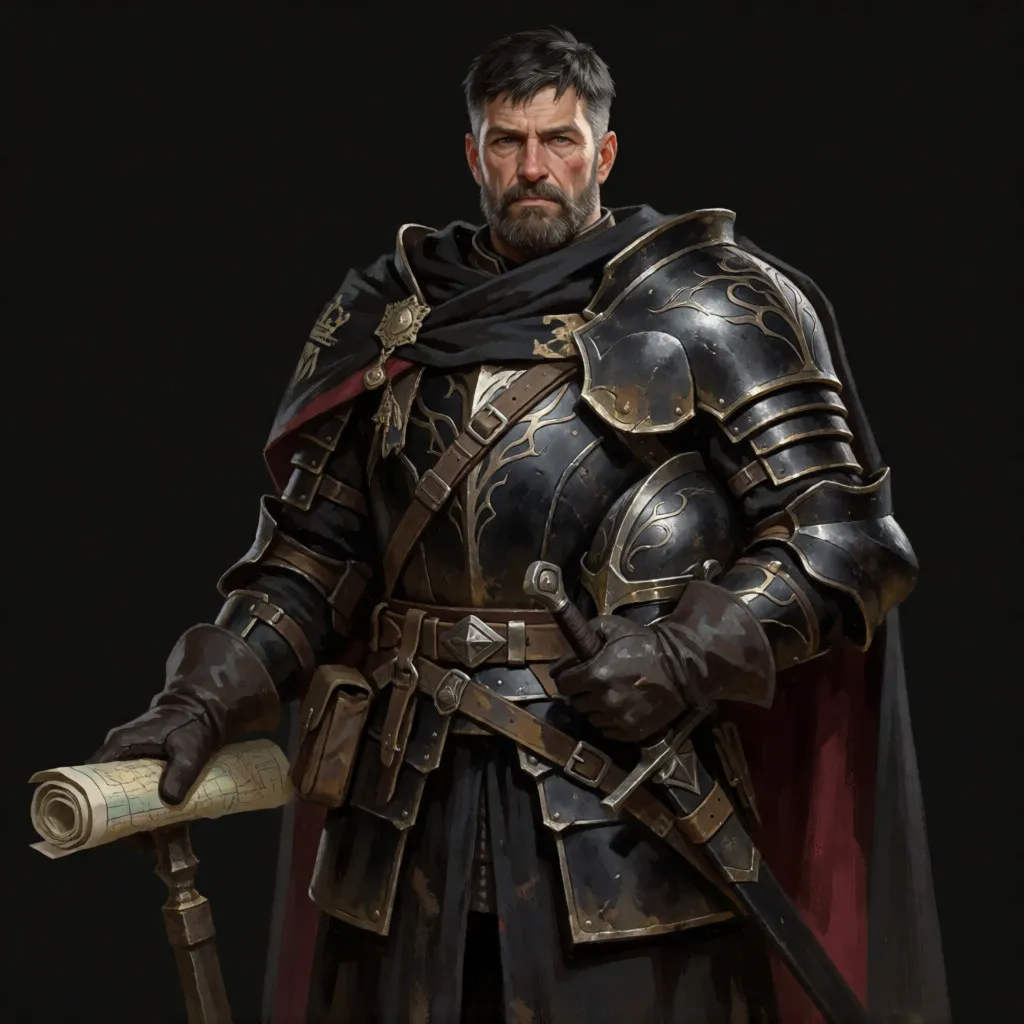
General Tharos commanded the royal army of Iskandar through the whole of its last war, and was the last man to hold that office. He was a professional soldier at a court of inherited power, and when the western tax road fell he argued for the war he knew how to win: seal the road at once, send two companies, finish the uprising before it spread. He was overruled by a king who sent his soldiers out under orders not to advance unless attacked.
He held no illusions about the dynasty he served. When the council complained that agitators were spreading lies — that the Veinwrights bound souls into walls and took children beneath the palace — it was Tharos who asked whether any of those claims were entirely false. Nobody laughed.
Twice the war turned on something he had not ordered. Weapons were found beneath the grain sacks on the road he had been sent to reopen, and he denied putting them there. Later he laid out a plan at Halren’s Bridge that should have worked — hold the eastern bank where the river narrows, and the rebels’ numbers would count for nothing — and then had to tell the king why it had not. Half the enemy were dead men.
After that his choices narrowed to which part of the kingdom to give up. He would not evacuate Greywatch, because abandoning the keep opened the eastern road; he would not have the risen put back in their graves, because without them the keep fell. Told that Iskandar could not be preserved by sealing away its parts, he answered that the capital still might be.
When the Justicar’s Legion came through the passes he called them allies and was told they were arbiters. He struck the table for quiet, asked whether Rusk would be preferred to them, and moved weapons to the loyalist strongholds while the negotiations went on. When the Legion required loyalist units to disarm for inspection, he refused outright — his soldiers, he said, had fought the dead as often as they had fought beside them.
He resisted at the Tomb of First Kings, and it was the last order he gave. He was held beneath the capital while the others went north and south, then brought before a Justicar tribunal in chains. He admitted the order. He denied authorising necromancy among civilians.
He is remembered as the general who lost Iskandar. He was also the only officer of that court who said out loud what it was.
Appears in
- The Civil War in Iskandar Three centuries of silence end on the morning the western tax road falls, and a court built to intimidate discovers it is surrounded.
- The Shadow Conspiracy A contract is refused in a gilded room and a second one is agreed, and a kingdom that has not yet heard of either is already being sold.