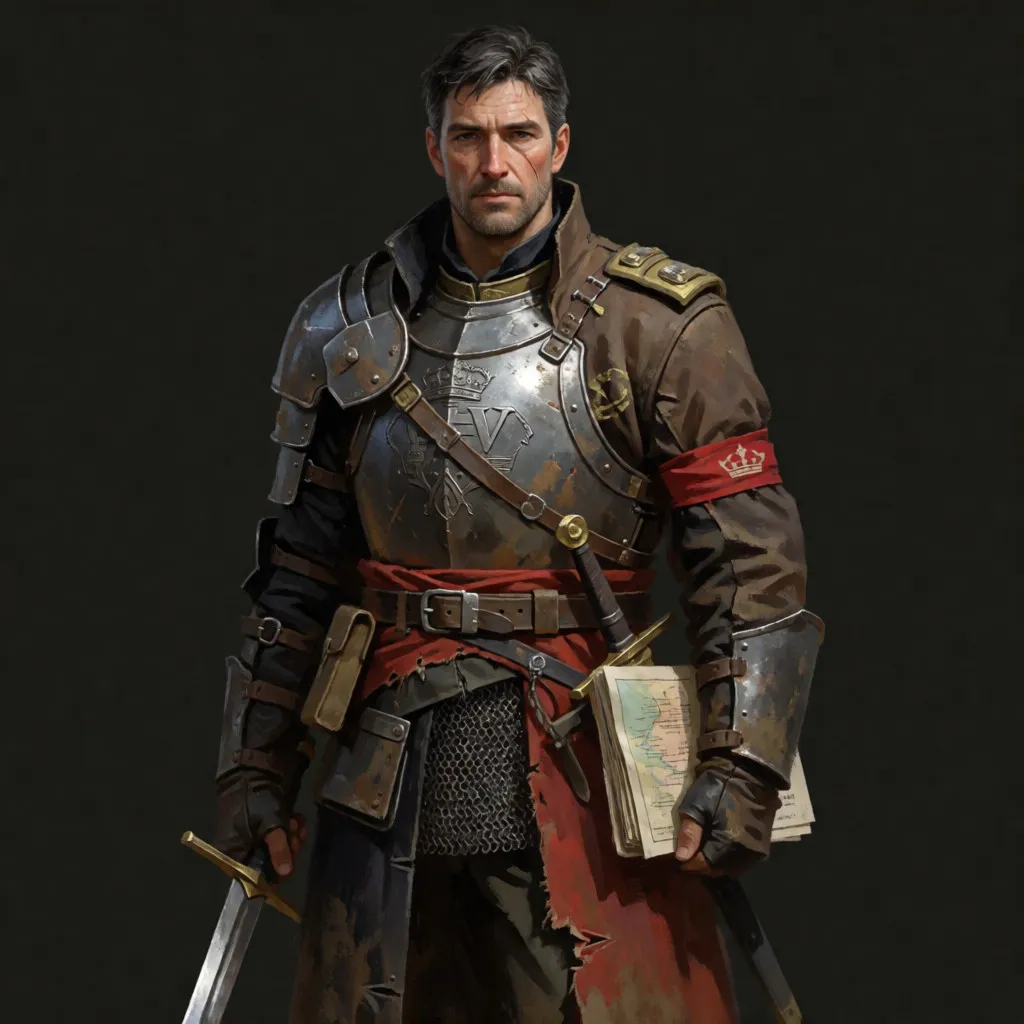
Darien Rusk
The man who raised the broken crown
Darien Rusk was a captain in the king’s army before he was the commander of the rebellion that ended it. He gave up his post at Blackwater Ford in the last weeks before the war — the royal army recorded a desertion, and he maintained for the rest of his life that he had resigned.
He was not the figure the songs later made of him. When the crown finally sent soldiers west to reopen the tax road, the man who came out to meet them wore a worn coat and an unevenly grown beard, with a scar across his left cheek earned in the same campaigns that had made General Tharos famous. Behind him stood people who looked tired rather than triumphant, which was what made them dangerous. What he asked for was narrow and practical: the winter levy ended, the mine debts suspended, the provincial councils restored. When he was refused he said plainly that this was the last chance before a war.
He won that war’s first real battle. At Halren’s Bridge he let his centre look close to breaking, closed it around the loyalist advance, and brought fresh companies out of the mist behind the northern hill — they had known where the royal cavalry would turn and when the loyalist centre would move. He rode into the separatist council afterwards in a commander’s armour of polished steel edged in gold, a hero with songs already being written about him.
He was also, from that point, the only person in the room arguing for restraint. Told to march on the capital because the royal army was broken, he answered that it was wounded, not broken, and that most of the realm believed the separatists were coming to erase them. He learned too late who was shaping that belief: when he demanded to know who would decide how the story got told, the door opened on a Gilded adviser and two veiled figures.
The rebellion outgrew him. Its ranks filled with people who no longer cared about charters or assemblies, warbands followed local chieftains instead of him, and provincial officers ran territory as private holdings. He opposed the unauthorised advance at Lareth Plain and took no part in the battle, and the defeat destroyed what was left of his authority anyway. The Free Provinces fractured; some councils surrendered, others called him a coward.
The Legion released him into supervised custody, meaning to use him as a witness. He escaped during a transfer west — it was said afterwards that the Shadow Weavers had allowed it, either to follow him to the last rebels or to be rid of him before he could testify. He found the survivors in the ruins of an old quarry, wearing scavenged Veinwright armour and captured Justicar weapons, the symbols of the rebellion cut or burned away. Some bowed to him. Some threw stones.
He was the only leader in that war to stand in front of the people he had lost and be told to his face what it had cost them.
Appears in
- The Civil War in Iskandar Three centuries of silence end on the morning the western tax road falls, and a court built to intimidate discovers it is surrounded.
- The Shadow Conspiracy A contract is refused in a gilded room and a second one is agreed, and a kingdom that has not yet heard of either is already being sold.