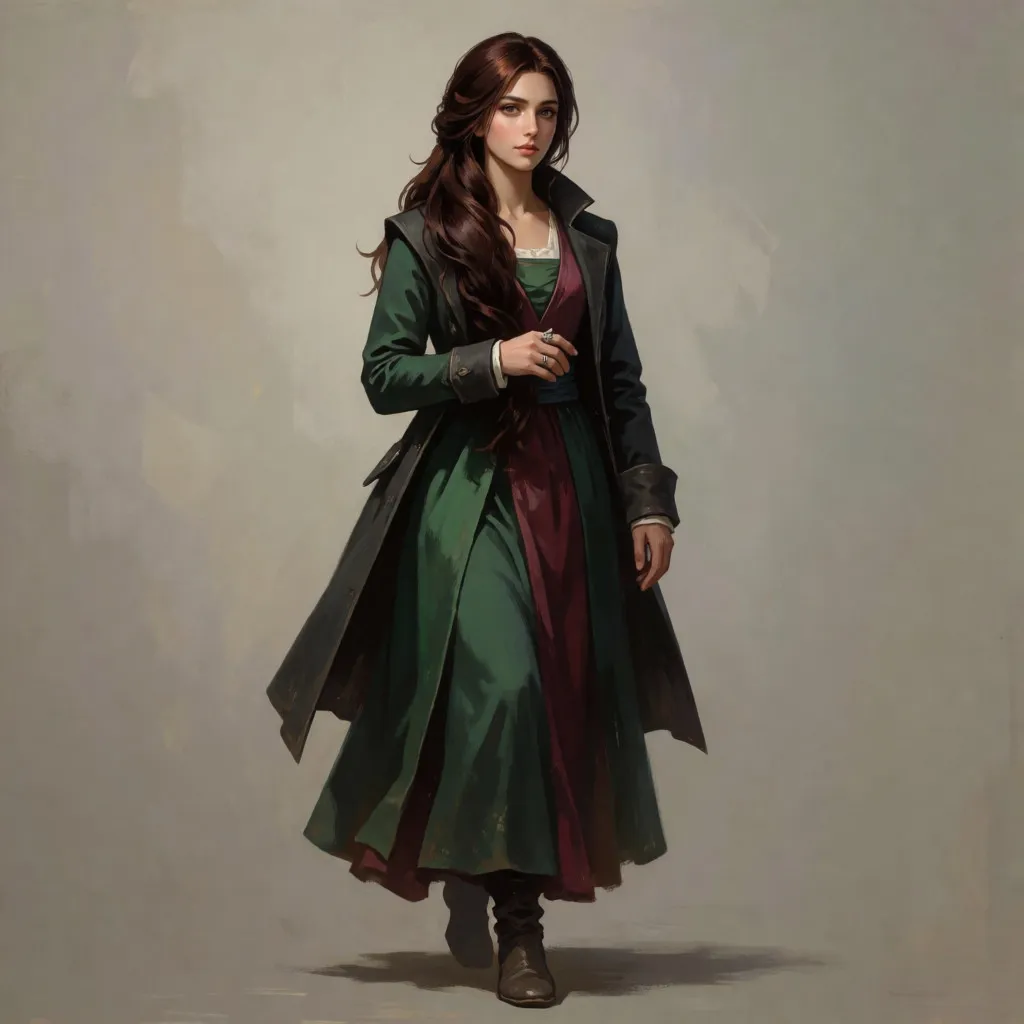
Zarina
The Golden Daughter
Zarina was the only child of the Supreme Ruler of Ashkar, and for the first twenty years of her life she was the most carefully loved person in the realm.
Her mother was the sister of the Phoenix Queen and died while Zarina was still an infant, which meant Zarina knew her almost entirely through other people’s faces. There were portraits in the eastern gallery and the Hall of Concord, and visiting nobles who stopped to say that she had her mother’s eyes, that her mother used to stand exactly like that, that her mother would have been very proud. Zarina learned early that the correct response was to smile. She remembered no voice and no hands. What she had instead was Balif, who could tell her that her mother sang badly, cheated at dice, burned bread and once threw a cup at the Supreme Ruler during an argument. Those details were the only version of her mother that felt like a person rather than a memorial, and Zarina hoarded them.
Her father was not the man the realm knew. Ministers straightened when he entered; Zarina crawled under the council table to get at a carved wooden lion and was carried out in his arms. He smelled of cedar oil and old parchment, his hands were always warm, and he sat on the edge of her bed when she could not sleep despite having half of Ashkar waiting for him in the morning. She was grown before she understood how few people ever met that man.
She was also grown before she understood what his fear had cost her. After her mother died he doubled the guard, altered the routes through the palace, had the food tasted and the carriages inspected twice. He did not think of it as control. At nine she asked to see the Lantern Festival from inside the city rather than from a balcony, and he refused, and then relented, and then sent her into the streets behind twelve mounted horsemen, a dozen soldiers, four attendants, two physicians and a captain who plainly expected the whole city to murder her. Guards cleared the road. Musicians stopped playing as she passed. Merchants refused payment. A boy her own age ran toward her with a paper dragon and was intercepted. Her own candle boat had been made specially, edged in gold leaf and painted with the royal crest, and she hated it the moment it was put in her hands. Asked afterwards whether it had been worth the arguing, she said yes, because she loved her father and he had done it for her.
What followed was not rebellion. It was competence. Balif had taught her to read early, to argue with history rather than memorise it, to spot an altered map and a forged seal. By sixteen she was standing beside her father at audiences; she interrupted one, on her second attempt at staying silent, because a river town’s figures did not match its testimony, and was right, and uncovered grain being diverted before it ever reached the water. At nineteen she pulled the weather returns against a southern uplands claim for road relief and established that the winter it described had not happened. The court began calling her the Golden Daughter. Her father thought the name harmless. Balif hated it immediately, on the grounds that people who give you a name usually want something from it.
She said yes to everything, and nobody ever made her. That was the trap. There was never an order — only a list each morning, and everything on it optional in the sense that the realm would not fall if she declined, and impossible to decline in the sense that somebody had already been told she was coming. Underneath it ran the thing she never said aloud: that her father’s pride was open and uncomplicated and easy to produce, and that it was the best thing in her life. She fell asleep with her face on a book about water rights. She stood three hours in a room chilled to the Crystalline Conclave’s preference with her hands going numb and could not afterwards have said what anybody had told her. She missed rides with Mira Saren until Mira stopped asking, and did not notice for weeks, and then found a pair of riding gloves at the bottom of a chest with the north fields still dried onto them.
When Mira was removed from the capital, nobody thought to tell her. She established the whole of it in half an hour, which was what made her angriest — it had never been hidden. Her father offered to have the family invited back and could not understand why the offer was unbearable. She refused it, locked Mira’s letter in a drawer that had never held anything but spare pen nibs, and kept the key, and found that the act had not felt shameful. It had felt like a room inside herself that nobody else had a door to.
She was twenty when she learned from a woman whose name she could not remember that a list of eleven houses had been drawn up for her marriage. She asked her father when he had been going to ask her, and he said, mildly and without any guilt at all, About what? Two nights after that she went down to a spring festival in the west quarter with Mira, wearing an old riding cloak, with no money, because it had never occurred to her that the world required any. Mira paid for the pastry she walked off with. A man carrying a crate shoved past her and told her to move, and she laughed until she had to stop walking, and afterwards remembered that nothing at all had happened and that it was the best night of her life.
Then she did the one thing she had sworn she would never let anyone do. She asked her father to restore Mira’s father to his post, out of love, so that Mira could stay — and he did it warmly and publicly, and Saren refused it, because an office given back by the ruler’s daughter is not an office but a debt, and every order signed in it would be read as hers. The family went further away and for longer, and this time because of her. Mira put on good clothes to come and thank her, and said the thing Zarina could not afterwards stop hearing: that there was no small size available to her.
She began studying her own home the way an intruder would — when the night kitchens changed staff, which supervisors looked at faces, that a person carrying something is invisible in a way a person with empty hands is not. She turned back twice. The third time she stood at the top of the service stair with her hand on the rail, and went down.
Appears in
- The Golden Daughter The most powerful man in Ashkar loves his daughter without limit, and builds her, one reasonable precaution at a time, the cage she will spend the rest of her life trying to leave.
- A World Beyond the Palace The palace was built to watch what comes in, and almost nothing about it faces the other way, so the Supreme Ruler's daughter walks out through the ash carts and finds a room where nobody has ever heard her name.