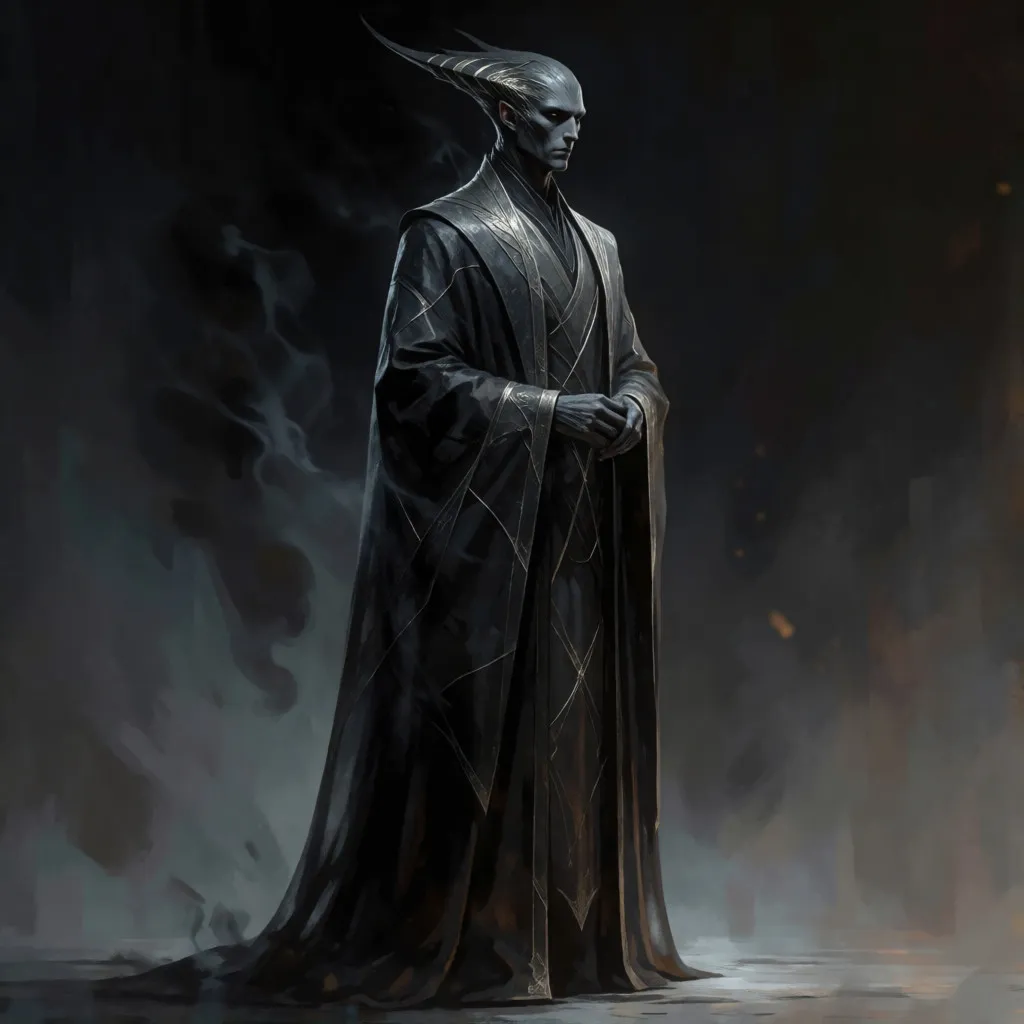
Sythren Vaal entered the Gilded Embassy at Iskandar past guards who had been instructed not to see him, and offered a name that meant nothing to the man he had come to recruit. That was ordinary. His guild used no titles outside its own circles, kept no capital that appeared on any map, and marched no army beneath a single banner. It was tolerated because every powerful house believed it could be used, and feared because no house knew who else had already used it.
He was tall and narrow beneath charcoal robes crossed by silver threads in a pattern that resembled roads on a map. His skin was grey and faintly translucent, and things moved beneath it. His eyes held silver at their centres and nothing else — no pupil, no white. In a lit room his shadow did not always agree with the lamps.
What he proposed to the Gilded Coven was not a rebellion. The Coven had already paid for one and discovered it would not hold together: too many grievances, no two of them the same. His contribution was to give them a shared explanation of the present rather than a shared future, and then to close every road back to reconciliation. He did not need to close them all. He needed people to believe the last one had been the last.
He worked through people nobody watched — stablehands, clerks, bargemen, registry workers, a courier who held one letter until morning. A garrison officer’s reports about hunger were never altered, only lost, until the officer resigned rather than fire on the starving and found the rebellion had claimed him before he had chosen it. A charter had three clauses replaced between its signing and its reading. An order General Tharos never wrote carried his genuine signature. A witness who remembered too much was removed from a guarded room without a door opening, because what he remembered would have complicated a case.
He was asked more than once what his guild wanted, and answered the same way each time. Access. Not gold, which purchases action and cannot purchase belonging — appointments within the Supreme Ruler’s court, recognition of Weaver agents as legitimate investigators, the right to cross guild borders under imperial protection, and sight of the sealed reports. When the Justicar’s Legion was finally summoned to judge Iskandar, he set about deciding what it would be permitted to see. He was paid in precisely what he had asked for, and the payment appeared in no contract, having been written instead into the shape of everything that came afterwards.
He told the Coven at the outset that they were not building something that could be controlled. He was the only one in the room who intended it as a description rather than a boast.