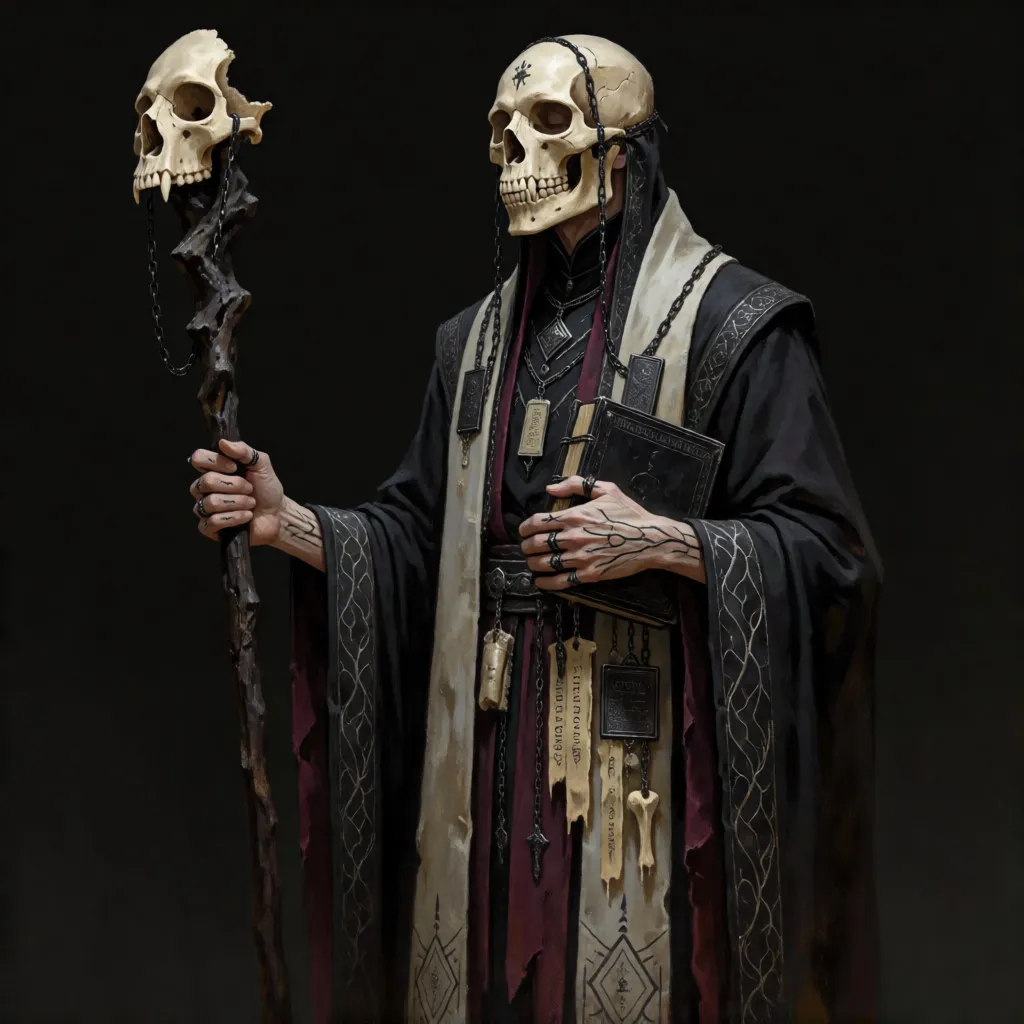
High Mortarch Selkos was chief priest of the royal cult of Iskandar, and the man who did the thing the rest of the realm came to believe King Varyon had ordered. His ceremonial mask was cut from the jawbone of a former saint, hung with small chains that clicked against it when he spoke, and he carried a staff of bone.
He held from the beginning that the war had nothing to do with grain. The hardship of the provinces, he told the court, was not the true cause of the unrest. He asked to be given the captured rebels so that he might question them beneath the palace, where ancestral spirits could separate truth from deception, and he was refused.
He argued the case for the dead openly and without embarrassment. They were, he said, a lawful instrument of the throne, and had served Iskandar since before the Veinwright line bore crowns. Told that every corpse the crown commanded created another rebel, he answered that perhaps the rebels should fear becoming useful. The king forbade necromancy outright. Selkos tilted his mask, and went on regardless.
Weeks before the siege closed around Greywatch he had already placed a disciple inside it — a thin, bald man wrapped in layered burial cloth who called himself Brother Caldris, tended the wounded, recorded the names of the dead, and was taken for a healer until the night he was not. Thirty-seven loyalist soldiers were raised in that keep. Pressed on the number, Selkos allowed that a small number of further casualties had been returned to duty. Confronted with the report, he said he had sent healers to several threatened fortresses; told plainly that he had sent necromancers, he inclined his head and observed that it had been a Veinwright fortress. That one keep did more to destroy Iskandar than the separatist army ever managed. It was the proof the realm outside had been waiting for.
He was imprisoned, and he escaped. Intelligence reaching the Justicar’s Legion through Shadow Weaver channels placed him inside the Tomb of First Kings, and the Legion surrounded it; Varyon rode there ahead of them and fought rather than see the graves opened. Selkos was not inside. Inspectors found preserved kings, mortuary texts and ritual vessels, and one narrow passage newly opened behind a founder’s sarcophagus, leading into the dark. The intelligence had been accurate enough to justify the search and false enough to guarantee the killing.
He was declared an enemy of the realm and never found. Rumour placed him in the crypts beneath Iskandar and among the western rebels in the same season, which is to say that nobody knew.
Everyone else answered for the ruin of Iskandar. The one who had actually done what the realm punished it for was not there to answer at all.