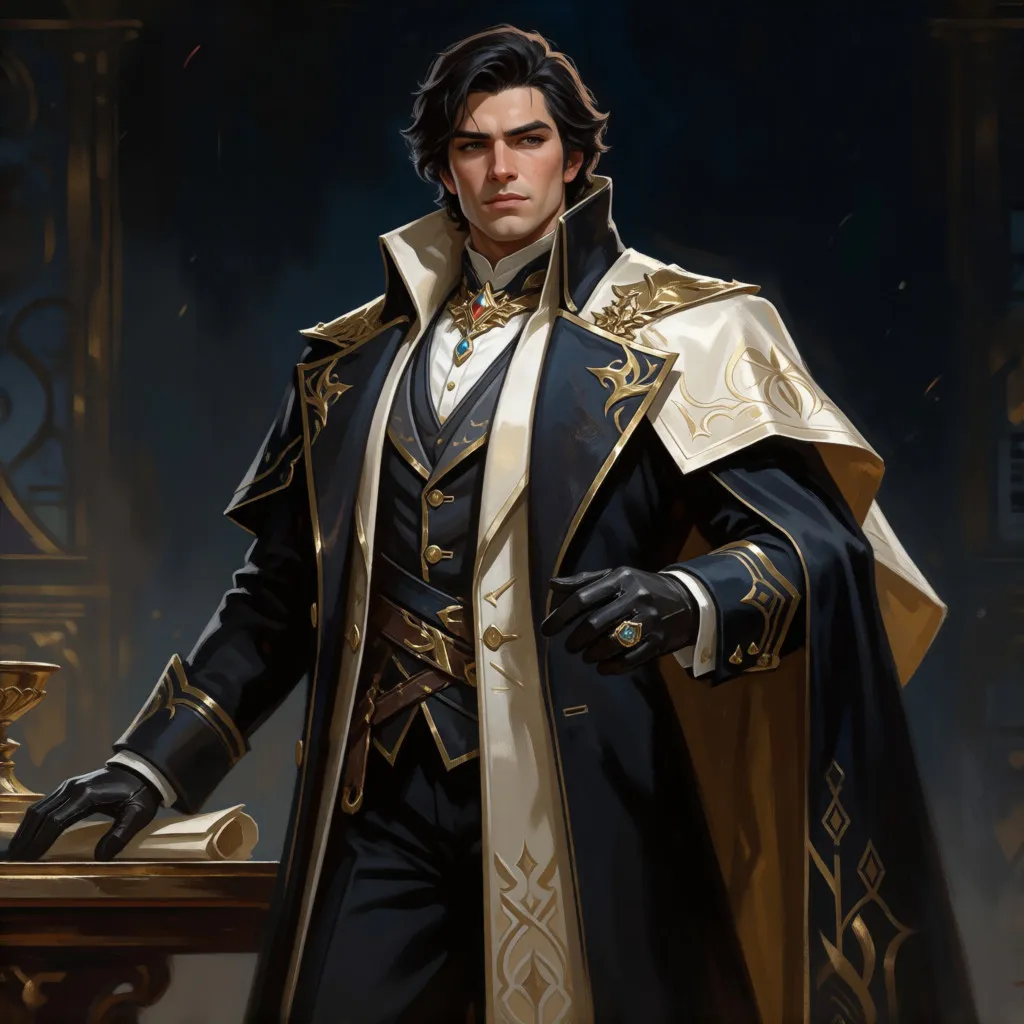
Odran Pell was the youngest man of consequence in the Mercantile Assembly during the Coven’s campaign against the Supreme Ruler, and the only one who ever tried to kill him without being told to.
He was broad-shouldered and expensively dressed and entirely incapable of hiding what he felt, which in that chamber was closer to a disability than a flaw. He was on his feet within minutes of the first accounting, demanding to know how twenty-eight million crowns could be owed on machinery half of which had never arrived, and had to be told twice to sit down. He did not believe the Sylvan groves were sacred and said so; told that the Supreme Ruler believed it, he called that wonderful and meant the opposite. He was not stupid. When the throne kept finding new contractors to replace the ones the Coven had frightened off, it was Odran, eating an apple in the corner, who pointed out that every block they placed was teaching the ruler exactly where their influence reached and where it did not. Cassovar Merent found the observation irritating precisely because it was correct.
What he wanted was to be heard. He addressed three thousand merchants in the eastern plaza without the Assembly’s authorisation, standing beneath a Gilded crest he insisted had already been there, and told them the crown was the reason they paid more for timber and transport and housing. Asked from the crowd what he would do instead, he said he would build. It was not sophisticated and it worked, and it made him briefly the most popular man in the Coven among young merchants and city labourers. Cassovar told him that if he lied badly enough the throne could answer him. Sarethe Vey told him he enjoyed the cheering too much. He said it meant they were listening; she said that was not the same thing.
He was the one who kept the conversation alive after the balcony. Cassovar had forbidden further action, so Odran began meeting men outside the Assembly — minor nobles, indebted merchants, people who had lost money in the expansion and thought Cassovar had become afraid. The hunting party in the northern foothills was his. No order was written and no payment was made in advance; the plan simply accumulated through suggestion until several men who had never done anything of the kind were waiting on a trail the Supreme Ruler had abandoned that morning because rain had washed out a crossing. One of them was caught carrying a Gilded coin purse and was poisoned in his cell before he could name anyone.
He never quite understood why that was worse than failure. When Cassovar told him that they no longer knew who was cleaning up after them, and therefore no longer knew who knew what they were doing, he took a visible moment to arrive at it. When Cassovar said the attempt could have killed people standing beneath the balcony, Odran said “So?”, and then watched his own answer land, and did not have another one.
He argued against stopping to the end, on the grounds that stopping was now more dangerous than continuing. He was told that if he made another attempt his name would go to the throne. He said Cassovar was bluffing, and was probably right, and stopped anyway. In the last meeting in the upper chamber he asked what they were supposed to do now and was told: go back to being merchants, lenders, ministers, landholders. He asked whether that was all. He was told the Supreme Ruler was not the only thing in Ashkar.
Cassovar had once behaved as though the ruler was the only thing in Ashkar. That was part of the mistake, and Odran was the only person in the room who had never pretended otherwise.