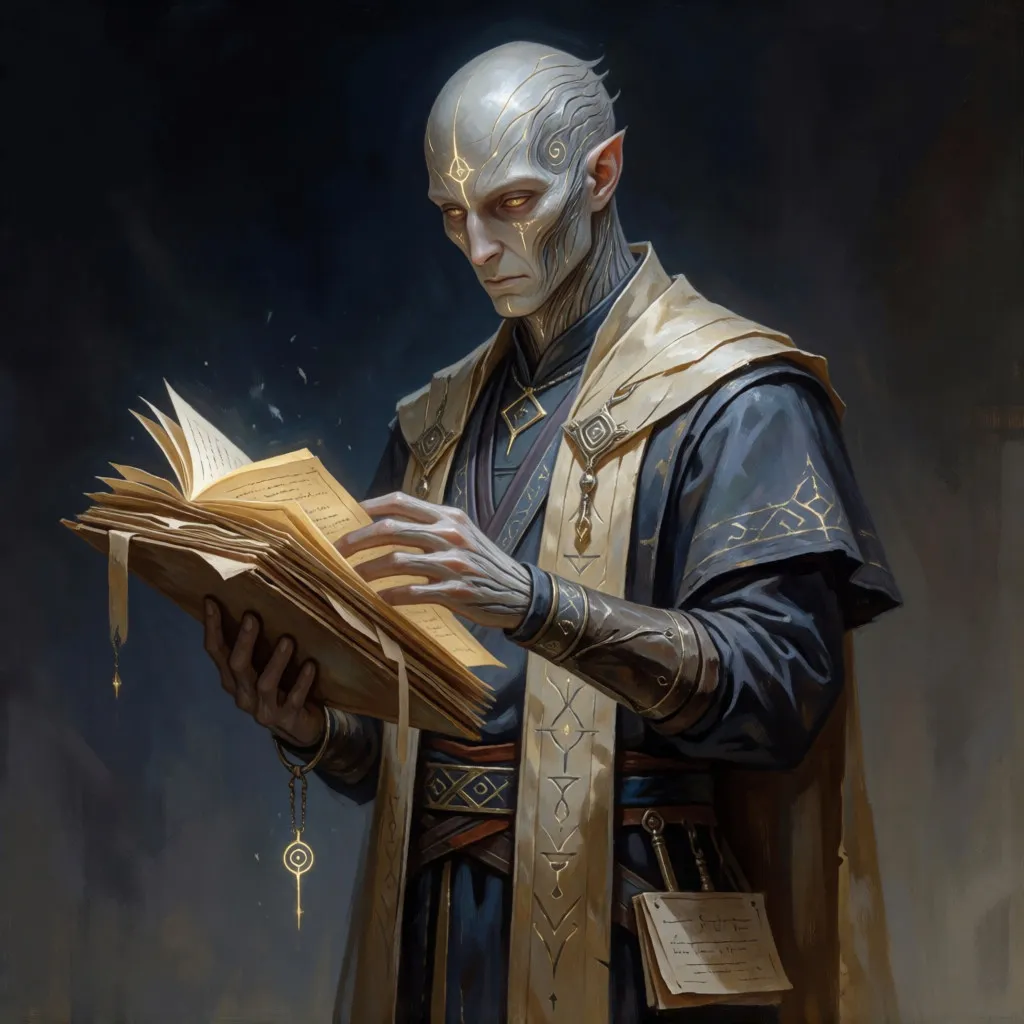
Iven Marr worked in one of the Arcanum Arcanorum’s administrative repositories, where royal proclamations and trade agreements and guild petitions and census copies sit alongside thousands of other documents nobody expects to matter. He was not important. That is most of why the story reached him.
He was not human, and nobody in the repository would have thought the observation worth filing. His skin was the grey of unpolished silver, his skull bare and traced with fine gold lines running back from the brow like an annotation no one had troubled to translate. The ears came to a point. The eyes were gold the whole way through. Balif never once asked about any of it, which was as close to warmth as their acquaintance ever came.
He had known Balif before Balif left the Arcanum for the Supreme Ruler’s court, and the two of them did not particularly like each other, which meant Iven had no reason to flatter him. When Balif needed forged requisitions examined without the palace knowing, he came to a records chamber after dusk and found Iven on a ladder, and was told the two documents were not the same ink. Told he could see that one was darker, Iven said that meant nothing, and that the second had been written with gall extract from eastern oak, and that the palace had stopped buying it the previous year. Asked whether he could trace it, he said he catalogued ink, he did not study it. Asked again, he agreed to find out, and then told Balif not to say good, because now he had to.
The Arcanum is supposed to stand outside guild politics, and the Supreme Ruler said so when he discovered one of its clerks was helping investigate the Gilded Coven. Balif’s defence was that he had asked a man to compare ink. It was a distinction that impressed nobody except Iven, which Balif considered sufficient.
Twice he brought Balif something nobody had authorised him to bring. The first was a bundle that had been deposited in the archive under an incorrect classification — provincial agricultural tithe — and contained Gilded payment records instead: property purchases, consulting fees, transport retainers, one charitable donation, and a large sum paid six months earlier to a dye importer that had ceased trading eight years before. He had found seventeen of them. Asked why he was showing them to a servant of the throne, he said that someone had hidden them in an archive, and that this usually means they were meant to be preserved. Or found. Neither of them could say which.
The second came a year later, in a tea shop near the eastern market, an hour late because he had changed routes. A payment schedule with no names on it: numbers, dates, account marks. One large payment shortly before a false physician entered the palace. Another after a poisoned dart was found behind a ventilation grate. A third after the diplomatic reception. Balif asked for a copy. Iven said no, and went on saying it, and did not fold when he was leaned on — these were not his to give. He had shown them, he said, so that Balif would know he was not imagining the pattern.
He was honest about what his own guild intended to do with them, which was preserve them. Not act. The Arcanum was not going to accuse one of the strongest guilds in Ashkar of trying to murder the Supreme Ruler when it could not prove who had paid whom for what, and Balif recognised the argument because he had made it himself to the throne. Asked how long the records would be sealed, Iven said there had been no decision. Asked who could reach them, he said very few. Told that a record sealed deeply enough is a record nobody knows exists, he answered that it would exist, and then agreed that this was not the same thing.
Asked whether the Arcanum was recording the affair itself — all of it — he took a long time and said: some things. That was all Balif ever got out of him.