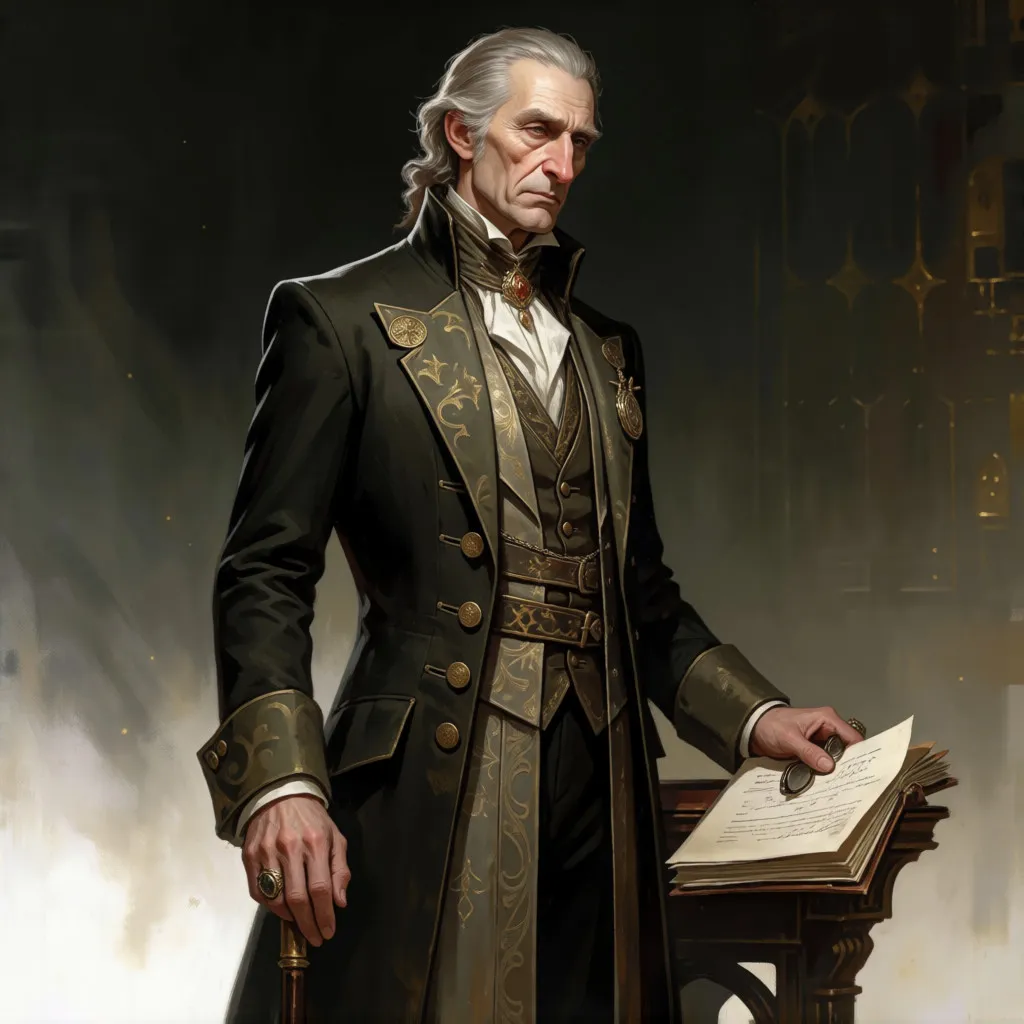
Emmeran Vos sat at the far end of the table through most of the Gilded Coven’s campaign against the Supreme Ruler and said almost nothing, and every irreversible step the Coven took began with a sentence of his that could not be quoted against him.
He was quiet, unremarkable to look at, and careful in a way the rest of them mistook for mildness. At the last meeting of that winter, with the campaign visibly failing, he observed that businesses fail for the same reason over and over: people keep paying for something after they know it is not working. Sarethe Vey told him this was not a business. He agreed that it was not, and said they were nevertheless spending a great deal of money trying to change one man’s mind, and that perhaps this was the wrong expense. Asked what he was suggesting, he said he had suggested nothing. He was correct. That was the point. Nobody had named the thought, nobody had proposed it and no vote had been taken, and after that evening it existed in the room regardless.
Months later, when a Gilded magistrate confirmed there was no lawful way to remove a Supreme Ruler, Emmeran said: then stop asking the law. The magistrate left. Emmeran said there were other ways people leave office. Cassovar Merent told him he kept crossing the same line, and Emmeran asked why he was therefore still invited, and Cassovar had no answer — which was the answer.
He had connections among contractors, which was how the balcony above the western court came to be inspected and marked for repair and never repaired. One contractor employed a mason; the mason had debts; the debts could disappear; the mason did not need to know why. Asked how certain it was, he said certain enough, and when Odran Pell asked what would happen if the ruler survived, he said that then it was an accident. When the mason was afterwards found beside a drainage canal half-dead and Cassovar demanded to know who had touched him, Emmeran said he had arranged a contact with a contractor and the contractor had spoken to someone else, and did not know who. He was not lying. That was the more frightening possibility.
It was Emmeran who found the Shadow Weavers, because he knew a great many people who claimed to know people and one who did not have to claim it. The approach came back to him as a folded sheet of grey paper inside his own morning accounts: an address, a time, and four words — come without House colors. He burned it, went alone to a warehouse in the old dye quarter, told a scarred man in a worker’s coat that he had work and that the work was a death, and was asked why. He refused to explain politics to an assassin and was informed that he had come to the wrong people. Twelve days later a black coin with a cut through its centre appeared inside his locked study, and no door had been forced.
Afterwards he was the one who dissolved the three companies, and the one who received the Weavers’ last short messages — conditions changed, access compromised, do not interfere — and the one who eventually noticed the black coin was gone from a locked drawer and could not say when.
He was never accused of anything, by the throne or by his own guild, and there is no document in any archive in Ashkar on which his name appears beside the word he spent four years declining to use.