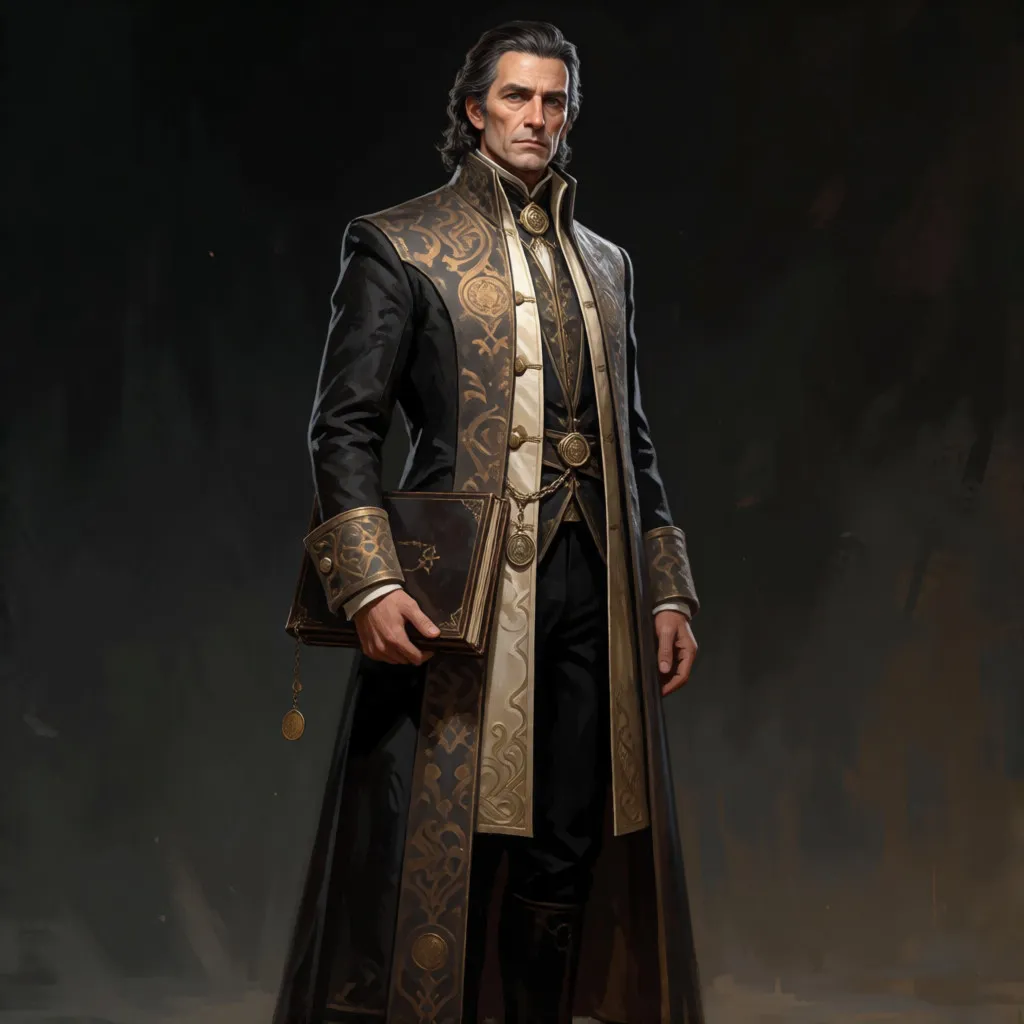
Cassovar Merent led the Gilded Coven’s response when the Supreme Ruler halted the expansion into Sylvan territory, and he led it for four years, from the first delegation to the last fire in which the correspondence was burned.
He read the decree twice and set it down on the blackwood table without tearing it. Men like him did not waste anger when numbers could express injury more precisely. He was lean and grey at the temples, unhurried in a room full of people who were not, and he had spent a career being the person who spoke last. Everything he did for the first year was recognisable as commerce: he took a delegation to the palace, he asked for the disputed sectors to be reopened, he was refused, and he accepted a compromise he considered an insult — compensation for approved works, surveyed alternative routes, arbiters for the contested boundaries. What the throne would not concede was the principle that enough investment creates entitlement, and that was the only thing the Coven had come for.
So he bought the argument instead. Pamphlets in five cities inside a fortnight. Merchants who found the halted expansion worth discussing in guild halls. Officials who began repeating the phrase “the cost of royal hesitation.” He never called the Supreme Ruler a tyrant, which would have failed immediately; he called him hesitant, detached, overcautious, a man who could not understand a changing realm. It cost nearly two million crowns and it moved almost nothing, because the ruler went to the abandoned construction camps, paid the stranded labourers out of the crown’s own purse, and then published the contracts proving the Coven had guaranteed those wages regardless.
He was not the man who first said the ruler should die. He was the man who did not stop the conversation. Emmeran Vos found the mason, and Cassovar’s contribution was to specify that if it happened it happened once — no improvisation, no second attempt, no loose ends — which Velisse Arquen told him to his face was the same thing as deciding. The balcony fell, three people below were injured, and when Odran Pell complained that they should have used something more certain Cassovar struck him hard enough to stop him talking and asked him whether he had noticed there were people underneath.
He forbade everything after that, and discovered that forbidding it was no longer within his power. Someone he could not identify had beaten the mason half to death. Someone else poisoned a frightened man named Terik Vann inside a guarded military post. He had built the conspiracy the way he built a trading house — intermediaries, distributed responsibility, nobody knowing too much — and the result was a chain he could not see from one end to the other. So he did the thing he had been avoiding, and paid the Shadow Weavers to make the next attempt the last one. They took half in advance, told him he would learn of it when it was finished, and then stopped answering him entirely.
He ended by telling Odran that another attempt would put Odran’s name in front of the throne, which would have exposed them all and which Odran correctly identified as a bluff neither of them wanted tested. He ordered the old correspondence burned. He instructed Emmeran to dissolve three companies. He sat with Velisse over a list of appointments the crown had quietly moved elsewhere and could not protest any of them without explaining why they mattered. Asked whether he regretted it, he said he regretted believing they could control what happened after they started.
He was the only person in the Coven who could have said when it stopped being about twenty-eight million crowns. Asked directly, by the one colleague still willing to ask him anything, he answered that he did not know — and that was the part that frightened her.