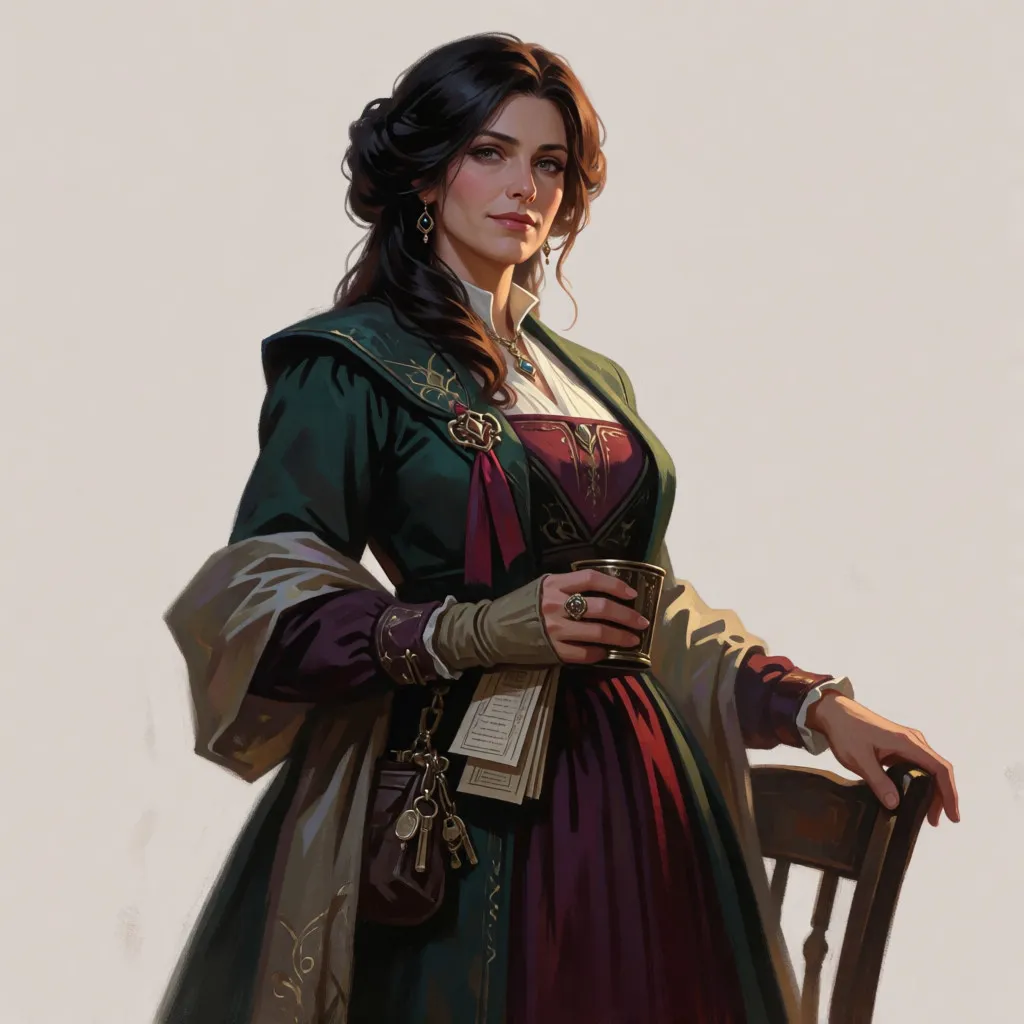
Carisse was a woman of the Velvet Veil who ran theatres for a living, the largest a great gilded barn on the river terraces, and kept a room under the roof of the Red House full of costumes too worn for the stage and too good for the fire. She was about forty, dark-haired and handsome, in green over wine-red, with a ring of keys at her belt that she touched as she talked, one key after another, as if she were counting them.
She noticed things. It was her gift and her trade. She noticed who hated smoke, who held a cup as if every glass were being counted, who had a face that would light a room and who had been kept. She found Sabra in a laundry at seventeen, folding sheets. She found Zarina, calling herself Sera, at a masked house in the river quarter, and moved her three steps out of the smoke before she had coughed.
Everything she gave was given as a gift, and none of it was ever asked back. A seat out of the draught. A cold drink nobody had ordered. A long green coat from her wardrobe, made for a girl who runs away from home in the second act, in a size that happened to fit. She never asked for anything outright. She did not need to. She had a way of saying, lightly, the one thing a person had never let themselves think — that some fathers love their families the way a man loves a house — and then walking away and leaving it burning.
She believed in the Veil’s creed entirely: that every limit is a cage somebody else built for you, and that to want a thing and have it is the only freedom there is. She spoke at Sabra’s wake more beautifully than anyone had ever spoken about anyone, and opened the mirror room again within the week.
In the year that followed she made Zarina the Veil’s emblem — the front rows of the river quarter’s playhouses, the green chair in the best salon on the river terraces — and when the watch went looking for the man who had thrown a tile from a roof in Bell Street, who was her own doorman, it was Carisse who sat on the edge of an empty stage and said, to nobody in particular, that nothing could be done unless someone knew when. She never wrote a word of what came of it in her own hand.
On the night Sera was recognised in the old market square, Carisse was the only face in the crowd that showed no surprise at all. She lifted her cup across the square, very slightly, as if to a friend.
Appears in
- Behind the Velvet Curtain The Supreme Ruler's daughter walks out of her father's palace under a name she invents, and finds a freedom that feels, for one bright year, like the first true thing anyone has ever offered her.
- The Daughter Renounced The morning after the square the Supreme Ruler's daughter stops hiding, and the Velvet Veil makes her its emblem; her father defends her long past sense, until the one person in Ashkar he never locked a door against carries his council's order across the river.